

The year 2022 was extraordinary. I was in for quite some twists and turns.
Of all my experiences that year, one stood above the rest — I had the opportunity to participate in a parabolic flight aboard a zero-gravity airplane. There I was, on the 22nd of November, floating in the cabin of the Airbus A310 ZERO-G, along with my crew mates from PaleBlue and the European Space Agency (ESA). Together we were testing our custom VR hardware to finalize configurations for flights to the International Space Station.
This was an event some years in the making.
I couldn’t help but wonder how I got here.
Rewind to 2019, when I met ESA astronaut Matthias Maurer. At this point, PaleBlue had already done some VR work for NASA Johnson Space Center, creating professional VR training solutions, but we had not yet had the chance to apply our tech to zero-gravity scenarios. So that year, I presented at the Spaceport Norway conference, showcasing our VR training capabilities for spaceflight. In the following break, Matthias approached me, and we discussed applying collaborative VR training in astronaut preparation. This was when we discovered our mutual belief in the power of VR to facilitate astronaut training.
On that day, the VR Zero-G project was born.
Since then, we have run several projects with ESA’s European Astronaut Center, all aimed at developing a 3D replica of the International Space Center and a virtual Zero-Gravity engine to enable astronauts to train in VR aboard the virtual space station.
Last year, the project approached its pinnacle as we decided to run a series of experiments aboard a zero-g airplane. One goal was to validate the quality of our virtual zero-g modeling by comparing real and virtual zero-g motions. Another was to test the zero-g behavior of VR and XR hardware to perform hardware selection for the International Space Station.
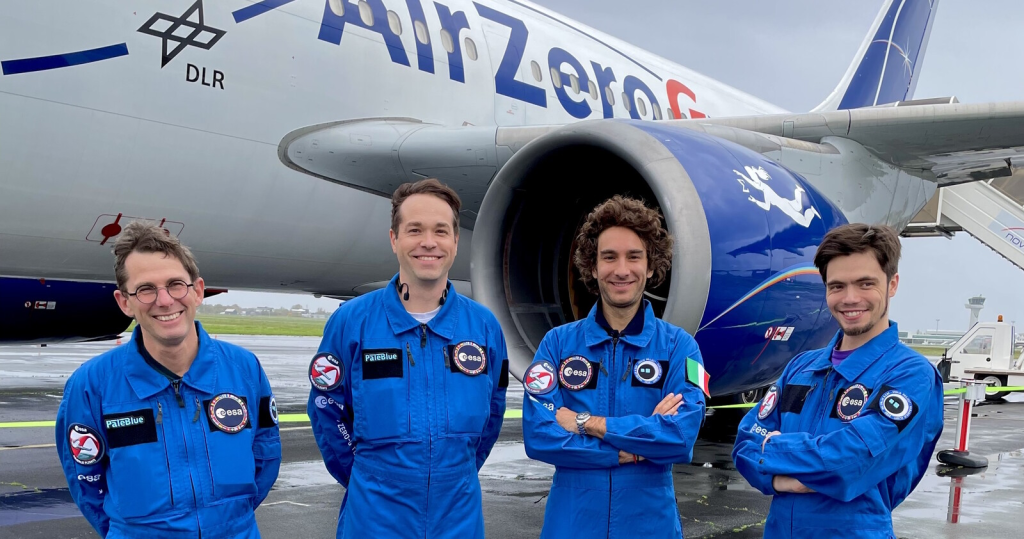
So on November 22, 2022, after months of preparation, we launched a 3-day parabolic flight campaign. I was the coordinator that day, and my colleagues from PaleBlue and ESA were on board as equipment operators and safety personnel. After a thorough safety briefing, the plane started accelerating and took off. It was still pretty much a normal airplane flight like any other, except for our blue flight suits. A few minutes later, we stood up from our chairs and assumed our positions in the cabin’s open area that had been set up with sensors, cameras, and protective netting. We were ready to step into mutually unknown territory — weightlessness.
I doubt my words can fully describe the magnitude of that moment, but I’ll try. You hear the pilot reading out “30… 40… Injection!” and suddenly, you weigh nothing. Immediately, you get this weird feeling in your stomach. You are in free fall, together with the plane and everyone in it. You are simply floating around with nothing pulling you down. A few seconds later, the feeling subsides, and you think, “This is so cool!” After all, this is something that can only happen in space and parabolic flights; it’s not an experience you can find anywhere on the Earth’s surface! We all looked at each other and smiled. This was real. We were there, and we were doing it.

For some explanation, a parabolic flight follows a sequence of normal gravity, double gravity, weightlessness, and double gravity again. This plane maintains its zero-gravity state for 22 seconds. We were to run 30 parabolas each day to gather all the data we needed. This was how we performed our zero-g experiments, 22 seconds at a time.
Before each period of weightlessness, the airplane accelerates, and double gravity kicks in. At this moment, it’s important to try and stare at a single point in front of you. If you don’t, you might provoke the uneasy feeling of motion sickness, which is greatly amplified at 2 g. Then after the weightless period, you have to wait out the 2-g phase again before setting up the next experiment.
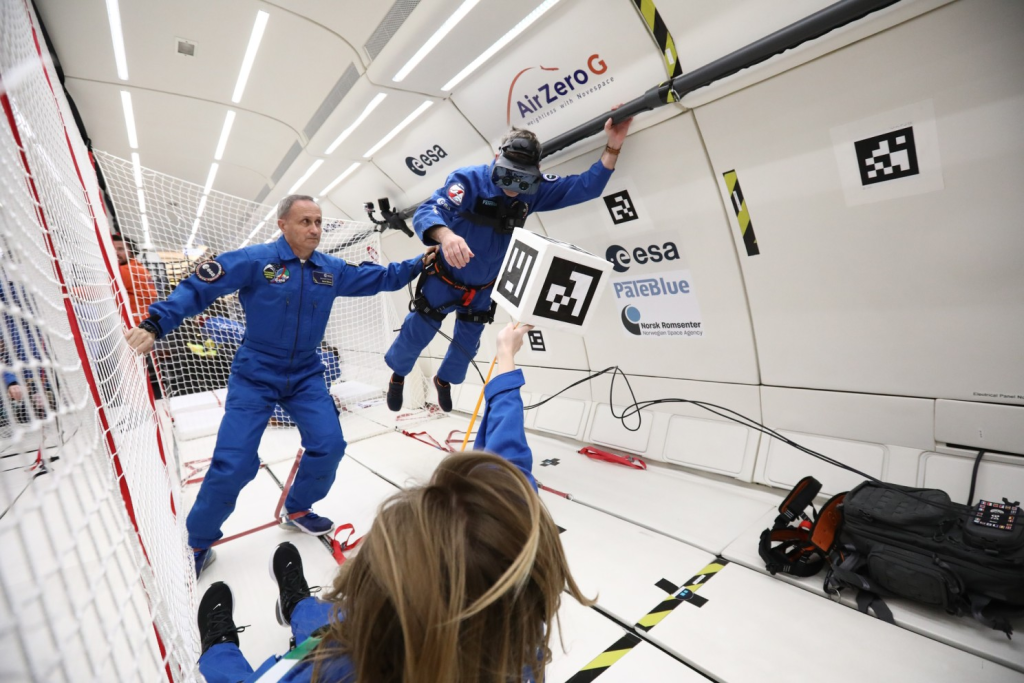
We ran our experiments according to a script. During the brief periods of normal gravity, I would read it out to coordinate the setup of our hardware. The equipment operator would then put on the VR headset while we assumed our positions to brace for 2 g. Next, the pilot would initiate the countdown to zero gravity. The moment it hit, we immediately started our equipment testing, shouting out the equipment’s behavior to each other to communicate over the loud drone of the airplane engines.
So how did it feel aboard the Zero-G airplane, floating around in weightlessness? Strangely, after spending years in virtual Zero-G in our simulator, it felt almost familiar, but it was still magical, to say the least. Perhaps sci-fi-ish would be more accurate. It felt like something one could get used to. And yes, I did get a bit nauseous briefly during our flights, but I managed to shake it off fairly quickly and get back on track.

We concluded three days of parabolic flights, taking shifts aboard. Despite logistical setbacks and an assortment of hardware and software malfunctions, we managed to complete our experimental plan: gather essential data for VR and XR functioning for use in spaceflight, and capture motions in true zero gravity.
At this point, we are still far from done. More software is to be produced. More hardware is to be configured. More experiments are to be run. But this flight campaign allowed us to capture crucial data that will expedite our progress toward eventually equipping humans with XR technology on space missions.
And I’m just thrilled I had a chance to be a part of this effort. And float in zero gravity for a little while.
This project wouldn’t exist without NoveSpace and the European Astronaut Center or support from Norwegian Space Agency and Innovation Norway. It wouldn’t exist without the amazing people at PaleBlue and ESA. Thank you. Working with you has been truly enriching. See you in space!